
Burlington Township Directory Shelf
No single shelf holds a continuous Burlington Township run. The Library of Congress lists a Burlington, New Jersey street-address volume for 1970-1971, and its county criss-cross holdings run from 1971 through 1995 with listed gaps. The New Jersey State Library holds telephone directories for Burlington from 1978-1989 and for the Burlington County Area from 1990-2005. Read the labels closely. Postal Burlington, Burlington City, Burlington Township, and the county-area circulation each cover different ground.
Treat a holding description as a lead, not a verdict. Ask the keeper to confirm the volume, date, and access terms before you lean on it. No publisher is established for the Library of Congress Burlington row, so leave any publisher out of a citation. A gap in a run is a gap in the evidence. It is not proof that nobody lived at an address that year.
| Collection lead | Documented years | Keeper | How to consult it |
|---|---|---|---|
| Burlington street-address directory | 1970-1971 | Library of Congress | Holding guide; confirm the volume before research |
| Burlington County criss-cross volumes | 1971-1995; 1975, 1984, 1993, and 1996 listed missing | Library of Congress | In person at the Book Service desk |
| Burlington telephone directories | 1978-1989; 1989 first page noted missing | New Jersey State Library | Holding lead; verify exact item |
| Burlington County Area telephone directories | 1990-2005; 1991 page 8 copy noted missing | New Jersey State Library | Holding lead; verify exact item |
| Family, newspaper, map, and directory materials | Varies by collection | BCLS and Historical Society | Ask staff for the matching series or file |
Note: A holding date tells you a book sits on a shelf, not that every Burlington Township street or household appears inside it.
Burlington Township Directory Place Names
Check the municipality before joining an old citation to a person. Burlington Township wraps around Burlington City in a horseshoe pattern. A street can carry Burlington postal usage yet sit under Township jurisdiction. Boundary lines blur further near the city edge. County records are usually routed through Mount Holly. The township's history adds one more twist. Burlington served as New Jersey's capital before Trenton. Older material may therefore use place names that fit no current mailing label. Record each name exactly as printed. More certainty is sometimes needed. Compare the street, house number, town label, and date against a tax map, a deed description, or a dated newspaper citation. Never quietly turn a historical Burlington entry into Burlington Township. That shortcut can attach the wrong municipality to a family line.
Burlington Township City Directory Years at the Library of Congress
The Library of Congress address-directory guide identifies a 1970-1971 Burlington street-address directory. It is a strong address-side lead, though far from a modern reverse lookup. Its companion criss-cross guide covers Burlington County volumes from 1971 to 1995. All are consulted in person. Plan ahead for a visit. Bulk requests need 24 hours of notice. The daily cap is 40 volumes, and staff do not promise broad name searches.
The street-address directory collection page itself lists the Burlington entry among its holdings.
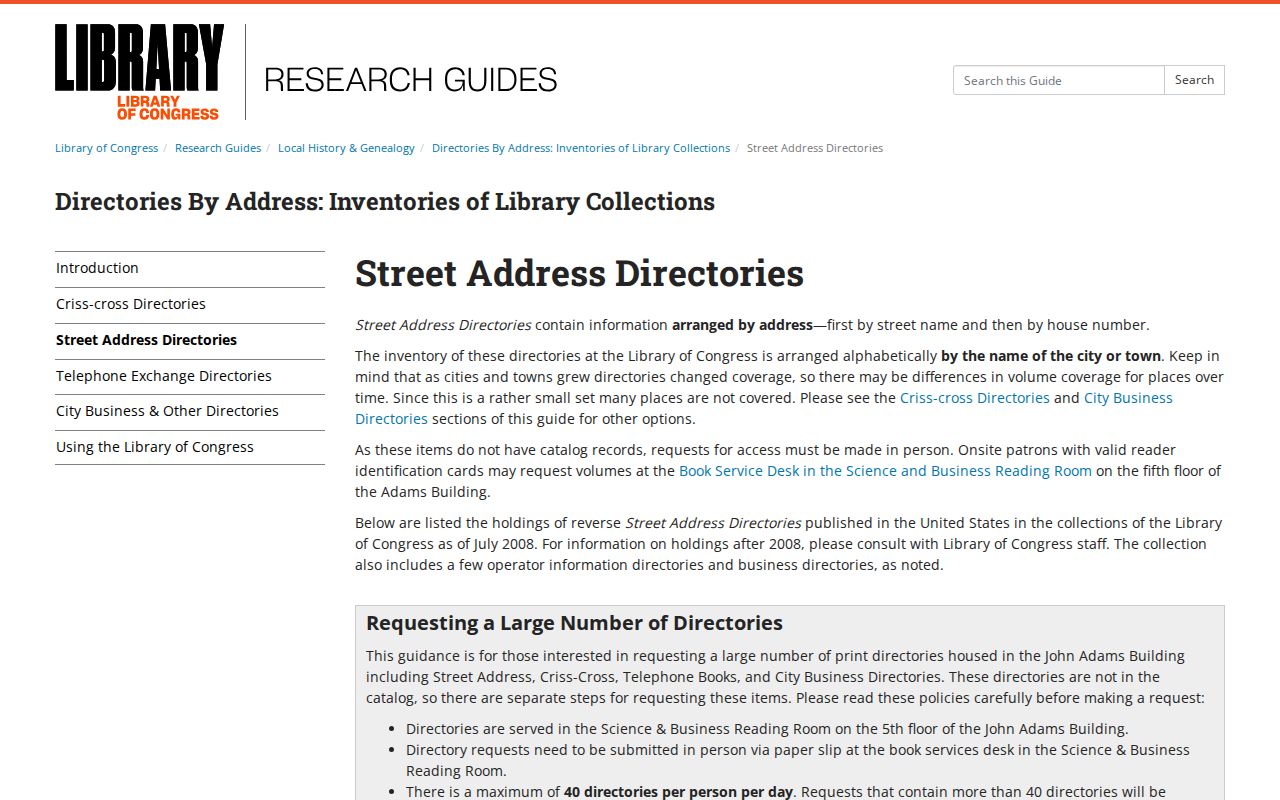
Confirm the holding lead on the Library of Congress guide page. Then frame a narrow request built around the access rules and the volume date.
Burlington Township Local History Leads at BCLS
A directory name gains real weight once you can anchor it to a date. The Burlington County Library System Local History and Genealogy collection is the best local bridge for that work. In-library Ancestry Library Edition and cardholder HeritageQuest access cover the census side. Newspaper notices and indexes include the Central Record and other local titles. They help pin a family to a moment. The digital postcard collection holds more than 400 images. That is useful for matching an old street scene to an address in a city directory entry.
The New Jersey Room goes deeper still. Its shelves hold family files, cemetery records, scrapbooks, and maps. Photographs, directories, wills, probate material, and microfilmed newspapers fill out the collection. Plan your visit through the BCLS Local History and Genealogy page, which lists each resource in full.
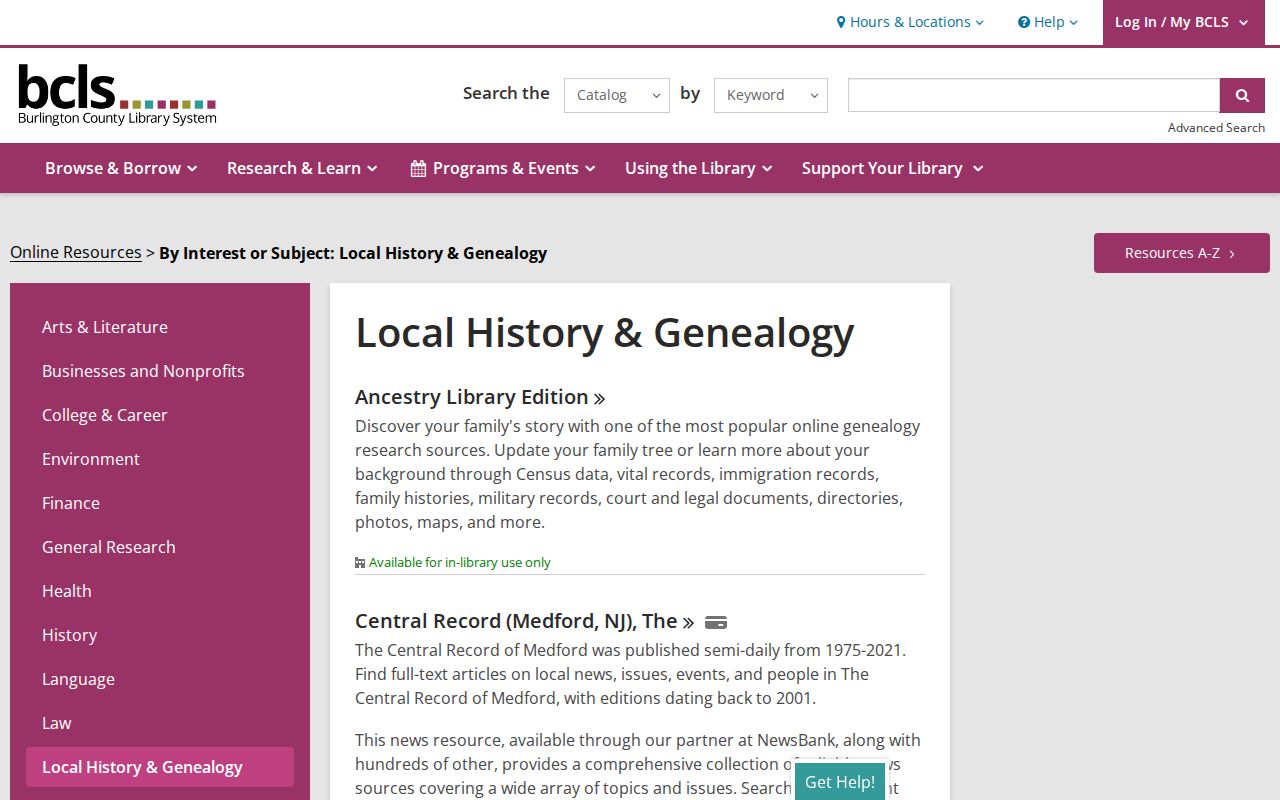
Bring a name variant, a street or town, an approximate year, and the resources already checked so staff can direct the request to a reel, index, file, or volume.
The Burlington County digital-history collection also describes the newspaper context. Nearly 10,000 reels have been microfilmed, although only a fraction of all holdings are online. A notice or citation can help date an address association, but it should be kept separate from a claim of present residence.
The following capture comes from the Burlington County digital-history collection.
Treat a digital image as a citation lead. Ask BCLS about the full reel or original collection whenever the image alone leaves a date or place uncertain.
Burlington Township Directory Context at the Historical Society
The Burlington County Historical Society Library and Collections holds far more than city directories. Deeds, maps, manuscripts, and family albums sit in its stacks. Marriage certificates, photographs, business records, rare books, and family files rest there too. You will find it at 457 High Street in Burlington. The listed phone is 609-386-4773. The posted appointment instruction is dated, so call ahead to confirm current hours and policy.
A deeper research request comes with a small but smart requirement. The Society's form asks which resources you have already checked. List the volume year, the newspaper index, the map, the archive search, and any spelling variants of the name. The form also sets terms: a non-refundable $50 charge covers two hours, and the estimated turnaround is 6-12 weeks. Five printed or microfilm copies are included, with extra copies billed separately. No file is guaranteed to be name-indexed, and a directory entry may simply not exist.
The full collection overview is on the Historical Society source page.
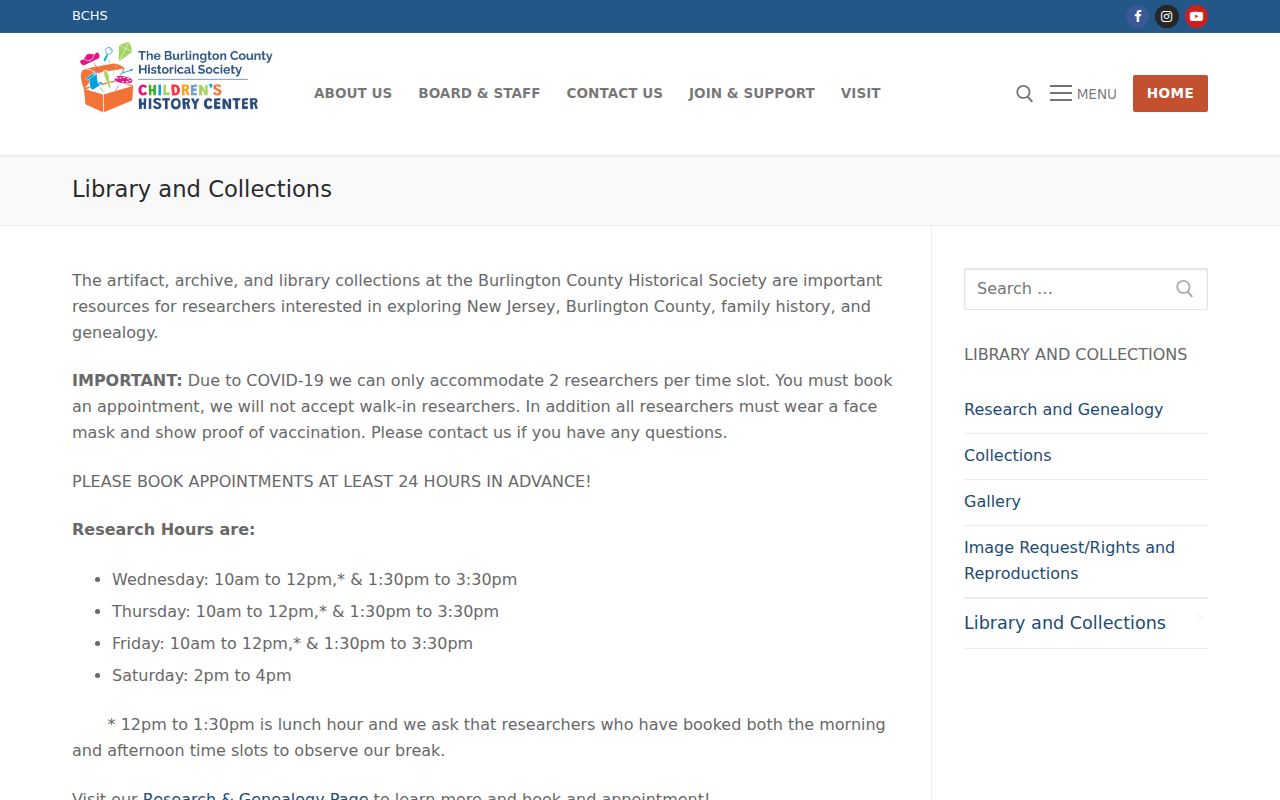
A thin Burlington Township residents directory entry gains real weight only when you pair it with another record role. A deed, a family file, a map label, a manuscript, or a cemetery transcription can each confirm what the printed line alone cannot. The historical society exists for exactly this kind of cross-checking. Human research on request can deepen the trail too. Note: A directory association stays an association, never proof of anyone's current address.
How a Burlington Township Directory Entry Reads
No freely reproducible Burlington Township entry appears in the official holding guides. So a household example would have to be invented, and that helps nobody. Trust only the fields actually printed in the volume you hold. A street-address arrangement may carry an occupant name. An owner or renter mark may appear too. Telephone details and other historical attributes round it out. Keep the roles straight: a subscriber, an owner, an occupant, and a business can be four different people. Any listing can sit stale on the page.
| Entry detail | How to read it |
|---|---|
| Printed name | Copy spelling, initials, punctuation, and any apparent variant exactly before normalizing it elsewhere. |
| Street and number | Record the address as printed and retain the town label. It may be an address-side entry rather than proof of household membership. |
| Role or mark | Use subscriber, owner, renter, business, or occupant only if the volume itself supplies that mark or context. |
| Telephone or attribute | Keep it as a period detail from that book. Do not treat it as a present contact channel. |
| Abbreviation key | Photograph or transcribe the key in the same volume before interpreting shorthand. |
- Criss-cross directory
- A volume arranged by street and house number rather than primarily by name, useful for checking who was associated with one address in that year.
- Householder index
- An index that points to a household or address entry when the volume includes one; its scope depends on the book.
- Abbreviation key
- The volume's own legend for shortened words and marks. Use it instead of importing meanings from another directory series.
Burlington Township Directory History in Layers
The Burlington Township record is layered, not linear. The 1849 Library of Congress Burlington County map named landowners and rural houses. Later directory and telephone holdings tied names and subscribers to printed addresses. Deeds capture transactions. Newspapers capture events. Family files preserve genealogical context. Keep each role distinct as you assemble a household trail.
- 1849: the Library of Congress county map supplies a dated landowner and rural-house snapshot, not a census.
- 1970-1971: the documented Burlington street-address directory provides an address-side holding lead.
- 1971-1995: Library of Congress Burlington County criss-cross holdings extend the street-and-number trail, with listed missing volumes.
- 1978-1989: New Jersey State Library Burlington telephone-directory holdings add a separate series, with a noted missing 1989 first page.
- 1990-2005: Burlington County Area telephone-directory holdings continue as a county-area lead, with a noted missing 1991 page 8 copy.
That layered view guards against a common mistake. An 1849 map label is a landowner clue only, not a current parcel owner or a modern household list.
Tracing Families Through Burlington Township City Directories
Family history works best from a dated entry, not a broad name search. Start by writing down the printed name, address, volume year, municipality, and any role mark. Then move forward and backward through the documented holdings. Never bridge a missing year with an assumption. Pair each directory date with a compatible record. That partner can be a deed, a tax ratable, a newspaper citation, a cemetery transcription, an obituary, a probate file, or an archive document. The New Jersey State Archives search route helps once the question outgrows a single volume. The BCLS New Jersey Room serves the same purpose for local depth.
- Confirm whether the printed place is Burlington Township, Burlington City, or a broader county-area circulation label.
- Copy the entry and the abbreviation key before creating a modernized name or address note.
- Check the closest earlier and later documented volume, marking every missing year as an unresolved gap.
- Compare the association with one independent, date-compatible source such as a deed reference, newspaper notice, map, or family file.
- Label the result by source role and date, then seek a custodian copy when a certified legal fact is required.
A historic directory finding should never be treated as current. When you need a present-day check, take the Burlington Township resident lookup path instead.
Burlington Township City Directory Match Confidence
One entry can be a strong lead and still fall short of a biography. Grade your sources. A direct image or index result deserves more credit than a directory association, a map label, a newspaper mention, or a family-file response. High confidence usually means a direct record, or two independent sources agreeing on date and place. Ambiguity should stay on the page when surnames, first initials, or municipal labels conflict.
Records vanish for ordinary reasons too. A run skips a year. A book draws a different circulation area. A name hides under a variant spelling, or access stops at a reading-room door. Describe each gap and its next lawful source instead of papering over it with a guess. Note: A city directory evidences a printed association on a stated date, never a substitute for an official certified record.