
Previous Residents Source Trail in Burlington Township
Begin with the time period, not a presumed household. Burlington County recorded documents, township tax maps, address directories, historical repositories, and department files each capture a different part of an address story. The best source changes when the question changes. A recent transfer may be in the online index, while an older ownership question can require the county archive and a directory association may be the only lead between two deeds.
Each row below is a dated connection, not a resident roster. The clerk records parties to an instrument. A directory records a subscriber or address association. A map may label a landowner. Keep those roles separate while tracing past residents of a Burlington Township property.
| Address source | Coverage or date rule | Custodian or access | What a match supports |
|---|---|---|---|
| PRESS recorded index | 2012 forward for block/lot and name; 1965 to February 2012 primarily name; earlier deeds elsewhere | Burlington County Clerk, online and public-computer channels | Recorded parties, dates, instruments, and prior references |
| Burlington County criss-cross directories | 1971 to 1995, with missing volumes | Library of Congress, in person | Name associated with a street number for a directory year |
| Street-address directory | 1970 to 1971 | Library of Congress holding | Address-arranged directory association |
| Burlington Township tax ratables | 1778 to 1822 cataloged run | FamilySearch catalog and historical research channels | Early assessed-property and place-name context |
| Permits, certificates, and plans | Local retention period not published | Township Licenses and Inspections or a specific OPRA request | Department-held project or address history, subject to redaction |
For a modern transfer, begin with the parcel identifier and PRESS. For a mid-century house question, add the criss-cross volumes. For an older tract, move into the separate archive, tax ratables, maps, and librarian-assisted collections. A blank result in one layer is a coverage question, not proof that no previous residents existed.
Burlington Township Previous Resident Date Ladder
The date determines the first clerk route. PRESS supports block-and-lot and name searching for records from 2012 forward. The county’s coverage note places 1965 through February 2012 primarily in an owner-name route. Deeds before 1965 require the separate Burlington County archive viewer, which is owner-name searchable. County maps before 1995 are not on PRESS.
That split matters when following Burlington Township previous residents. Record the selected mode, date range, spelling, and whether the result was an index entry, image, or archive lead. The Clerk makes remote searching and public computers available, while copy services and certification remain separate access channels. Online images may be unofficial or watermarked, so use the Clerk’s copy process when an official copy is needed.
Research cue. A no-hit result often signals the wrong date band, an owner-name variant, a trust or business party, or an earlier archive route.
Trace Burlington Township Previous Residents
Use the current parcel only as a starting point. The township tax-map index, the county parcel layer, and New Jersey’s statewide parcel material help identify municipality, block, lot, and qualifier. Then run that identifier in PRESS and inspect the document date, type, parties, legal description, and cited prior instrument. A current assessment is annual data, and an owner field may be redacted under Daniel’s Law.
The recorded sequence is about title transactions, not continuous occupancy. A transfer can involve an estate, trust, business, lender, or correction. Compare the legal description and block/lot at every step. Those stable parcel references are safer than relying on an old postal string or matching a common surname.
- Normalize the address, confirm Burlington Township as the legal municipality, and save the block, lot, qualifier, and tax-map sheet.
- Find the latest relevant instrument in PRESS by parcel identifier, name, or date. Note the recording date and the prior reference before reading the image.
- Read the grantee as the buyer in that transaction and the grantor as the seller or transferor. Search the earlier party and cited reference for the next link backward.
- Repeat while the description and parcel identifiers match. Keep entity, trustee, estate, and individual roles exactly as printed.
- When the online coverage ends, use the pre-1965 archive, deed books, microfilm, the FamilySearch catalog, or a Historical Society request rather than assuming the chain ended.
- Grantor and grantee
- The grantor transfers an interest; the grantee receives it. Neither role alone proves an occupant.
- Chain of title
- A dated sequence of recorded transfers tied to the same property description or parcel identifiers.
- Criss-cross directory
- An address-arranged directory used to find the name printed at a street number in one year.
- Enumeration district
- A geographic unit used to organize a census schedule, useful when a dated directory association needs a wider household record.
Burlington Township Previous Resident Roles
A good address history uses source roles rather than one sweeping label. A tax record may show an owner’s mailing address or a legal entity. A deed may identify a former seller. A directory may list a phone subscriber. A court caption can carry an address for service. Each may be useful, but none automatically proves that a named person lived at the property on the date being asked about.
Set a confidence label beside each connection: direct index or image, directory association, map landowner, newspaper mention, or unverified lead. A strong conclusion normally needs a direct record or two independent associations that fit the same period. That simple discipline keeps previous-resident research honest when a house has changed hands, been divided into units, or been held in trust.
Burlington Township Previous Resident Directories
Deeds rarely explain every year. The Library of Congress holds a Burlington street-address directory for 1970 and 1971, and its Burlington County criss-cross holdings span 1971 through 1995 with missing volumes. The New Jersey State Library’s telephone-directory list continues Burlington and Burlington County holdings into the 2000s. These materials are the practical bridge between recorded transfers.
Use a directory entry as an address association, then check a dated record from another collection. The fuller shelf and access rules belong with the Burlington Township city directory collections; use them here to test a particular house number, not to rebuild the entire historical catalog.
Here is the relevant Library of Congress criss-cross directory route for address-based research.
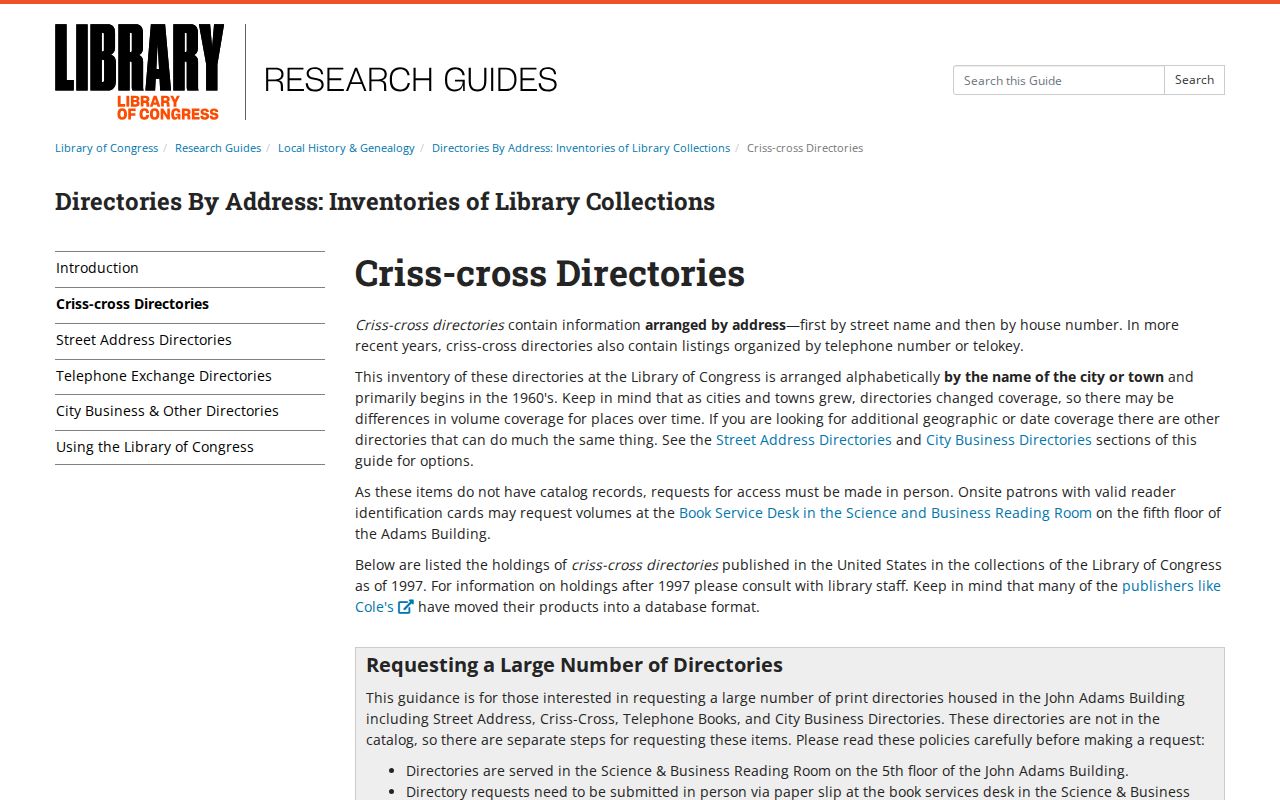
The access limits and missing-year notes explain why a quiet year in the record trail should be marked as a gap rather than filled with a guess.
Burlington Township Previous Resident Research
When the available index stops, human collections are a real access channel. The Burlington County Library System New Jersey Room can route questions to family files, cemetery material, newspapers, directories, maps, photographs, wills, and probate resources. Supply the street, approximate year, name variants, and the sources already checked so staff can point to the right series.
The Burlington County Historical Society holds deeds, maps, manuscripts, family files, albums, business records, and cemetery material. Its research form documents a $50 charge for two hours and a six-to-twelve-week turnaround. The request can ask about a deed file, family vertical file, map, photograph, or cemetery connection, but it does not promise a dedicated house-history result.
- List the address as printed in each era and retain alternate spellings.
- Include PRESS search mode and date range, tax-map sheet, and directory volume checked.
- Ask for one defined record category and date period at a time.
- Keep the reply as a cited lead until a primary record confirms it.
Older Burlington Township Previous Resident Records
The 1849 Burlington County map offers an earlier spatial snapshot with named landowners and rural structures. It can help explain an old tract description, a road reference, or why a modern address does not match the older record language. The map does not supply a complete census and a landowner label is not evidence of current ownership or residence.
Burlington Township’s geography also needs care. The township forms a horseshoe around Burlington City, and older materials can use Burlington without making the legal municipality clear. Keep the municipality, county, postal city, ZIP, and likely custodian in the research log. A Burlington City record should not quietly become a Burlington Township address history.
Rate Burlington Township Previous Residents
A useful final record is a timeline, not a name pile. Keep the address as printed, date and source, person or entity as printed, record type, role, block/lot or instrument reference, confidence, and any unresolved ambiguity. This preserves the difference between a title party, an assessed owner, an occupant association, a map label, and a newspaper lead.
Pair directory years with broader household and family-history sources only when the dates and address fit. BCLS newspaper indexes, cemetery materials, obituaries, probate references, naturalization records, and Historical Society files can add context at the end of a trail. They should not be used to make a current-person claim. A person disappearing from a directory may have moved, died, changed service, or simply gone unlisted.
| Timeline field | Why retain it |
|---|---|
| Address as printed | Shows historical spelling, unit, route, or tract wording without silently normalizing it. |
| Source date and role | Separates an instrument party, assessed owner, directory association, or map landowner. |
| Parcel or instrument reference | Keeps the candidate tied to the same ground when names repeat. |
| Confidence and gap | Shows which statement is direct, corroborated, or still an unverified lead. |
Lawful use. Burlington Township previous-resident research fits family and house history; never use a record trail to harass, follow, or expose a living person.